The History of Shunning
Shunning – A Brief History – Next: 4b – Coercion to Be Baptized
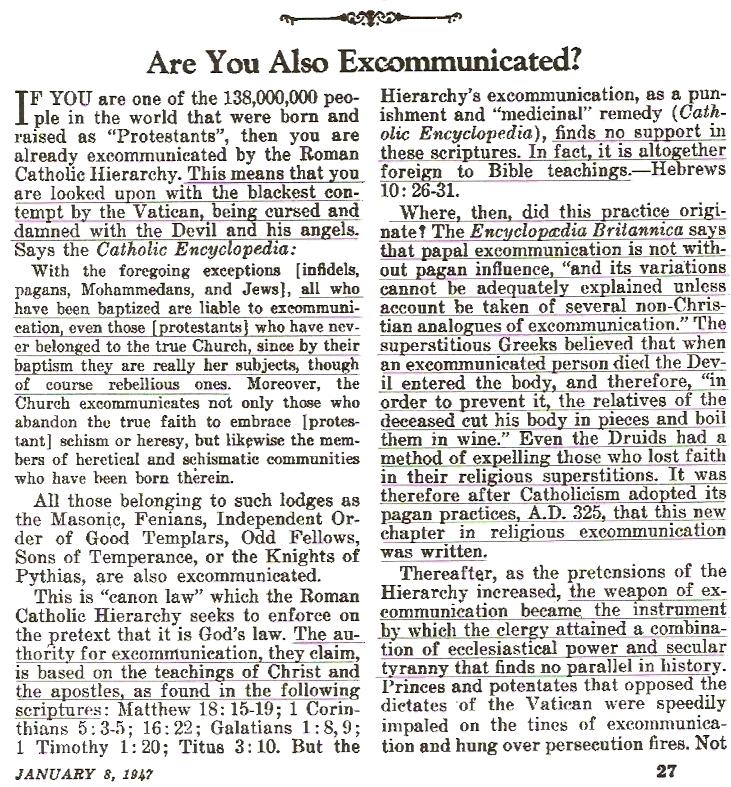
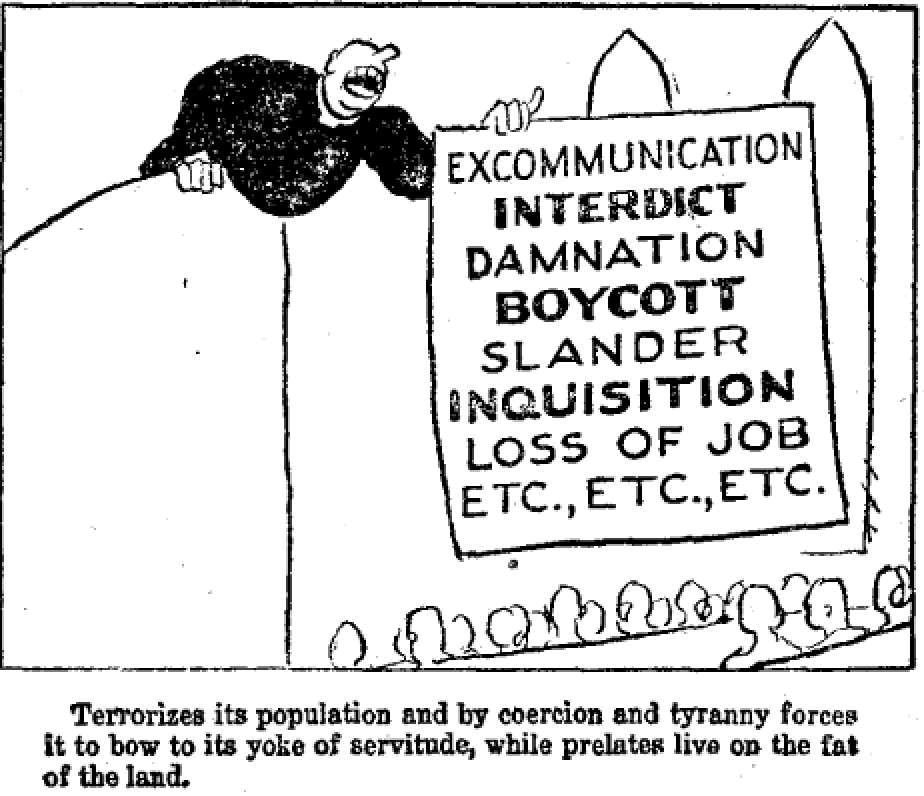
In 1947, the Watch Tower Society published a lengthy article [1] criticizing the Roman Catholic Church for its practice of “excommunication.” Among other things, excommunication was called a weapon used for power and unparalleled tyranny. The article called excommunication a punishment with “no support in the scriptures” and “altogether foreign to Bible teachings.” (The Watch Tower Society previously published an article that described the Catholic clergy as using excommunication to terrorize its population by coercion and tyranny.) [2]
(See footnote on excommunication) [3]
However, in 1952, the Watch Tower Society introduced its own punishment, using the term “disfellowshipping.” [4]
Compared to the consequences of Roman Catholic excommunication, disfellowshipping would prove to be draconian, even being described by the Watch Tower Society as an “extreme measure,” [5] as well as the “greatest punishment” that can be inflicted by man, [6] [7] but that this “helps” the accused, [8] and is a “loving provision.” [9] Remaining members were now to have absolutely no contact with a disfellowshipped member. Even the young should shun their friends, as this ‘brings pleasure to God.’ [10] This applies equally to family members, [11] [12] [13] with the exception of family living in the same household, as in a minor still living at home, or a married couple.
A 10-year-old Jehovah’s Witness being applauded for shunning her sister (2018)
A remaining member that ignores the requirement of shunning will himself face the consequence of being disfellowshipped. It has become a ‘shun or be shunned’ policy. [14] [15] [16]
Members are to consider disfellowshipped members as being dead, and strictly avoid contact with them. [17] [18] [19] This includes not even mourning a disfellowshipped family member that has died. [20] Children are not exempt, and will be disfellowshipped, and considered to be dead, even to immediate family. [21]
Disfellowshipped members are under “Satan’s influence,” which is a threat to the other members and relatives. [22]
The Watch Tower Society considers an engagement to be married to be a very serious matter, and makes reference to Israelite times when an engaged couple were considered to be as though married. Breaking off an engagement disqualifies a person from being considered an exemplary Jehovah’s Witness. [23] [24]
Despite the serious nature with which an engagement is viewed, if one party of an engaged couple is disfellowshipped, then the other MUST break off the engagement, or be disfellowshipped himself. [25]
The 1970’s brought mixed change to the policies around disfellowshipping. Additional reasons to become disfellowhipped were added, such as using tobacco, and anal or oral sex, even by a married couple – and it was indicated that even further additional reasons for disfellowshipping were yet to come. [26]
However, in 1974 the Watch Tower Society relaxed the stringentness of the policy, differentiating between someone deemed to be a ‘deceiver and antichrist,’ versus someone who had temporarily committed a sin. The Watch Tower Society was now encouraging a “balance in viewpoint”. [27]
In particular, families with a disfellowshipped relative were now allowed the choice of whether or not to have a relationship. [28] Also, it would not be inappropriate to hold a funeral at the Kingdom Hall for a repentant, yet still disfellowshipped member, if they were not considered to be an “aggressive apostate.” [29]
This relaxation of the policy would not be long-lived.
In 1981, the Watch Tower Society brought back the policy that all ex-members must be completely shunned, family or otherwise. (Once again, a funeral for any disfellowshipped member could never be held inside of a Kingdom Hall. Similarly, Jehovah’s Witnesses do not attend weddings of a disfellowshipped member, whether a close relative or not. Likewise, disfellowshipped members are not allowed to attend wedding receptions of a Jehovah’s Witness, whether a relative or not. [30])
In addition to ending the “balance in viewpoint”, 1981 also brought about an additional new policy – “disassociation.”
When a person is disfellowshipped, an announcement of such is made to the congregation. Originally, the announcement was: “So-and-so has been disfellowshipped for adultery, smoking, fornication, etc.” Legal challenges resulted in the announcement being changed to: “So-and-so has been disfellowshipped.” Further legal challenges resulted in the announcement being changed to its present form: “So-and-so is no longer one of Jehovah’s Witnesses.”
The policy of “disassociation” was introduced in 1981. The Watch Tower Society describes it as: “The term “disassociation” applies to the action taken by a person who is a baptized Witness but deliberately repudiates his Christian standing by stating that he no longer wants to be recognized as, or known as, one of Jehovah’s Witnesses. Or he might renounce his place in the Christian congregation by his actions, such as by becoming part of a secular organization that has objectives contrary to Bible teachings and therefore is under judgment by Jehovah God.” [31]
Therefore, if a member tells an elder that he no longer considers himself to be a Jehovah’s Witness, or submits a letter of resignation, he is considered to have disassociated himself. Likewise, if he attends services of, or joins another religion, or supports or works for disapproved entities such as the military, the United Nations [32], the YMCA, a political party, etc., one is considered to have disassociated, even though not having stated so. Celebrating certain holidays such as Christmas will result in expulsion, usually as having disassociated oneself. A person that takes a blood transfusion is considered to have disassociated himself. [33]
The consequences of disassociation are identical to that of disfellowshipping – mandatory complete shunning, including by close family. [34] An announcement is made to the congregation that is identical to the disfellowshipping announcement : “So-and-so is no longer one of Jehovah’s Witnesses.” Hence, the other congregation members are left to speculate as to the morals of the ex-member, even though the expelled member has done nothing but change their religious beliefs.
(For a more thorough history of the Jehovah’s Witness policy of shunning, visit https://jwfacts.com/watchtower/disfellowship-shunning.php#history )
Next: 4b – Coercion to Be Baptized
Awake! magazine, January 8, 1947, page 27 – https://jwfacts.com/images/g47-jan-8-p.27-excommunication.jpg ↑
Consolation magazine, November 3, 1937, page 21 – https://jwfacts.com/images/consolation-1937-nov-3-p21-excommunication2.png ↑
The reality of excommunication is that it is far different than was described by the Governing Body in their magazines above. Excommunication prohibits the person from receiving the sacraments, but has no impact on his relationship with other church members.
“According to Bishop Thomas J. Paprocki, “excommunication does not expel the person from the Catholic Church, but simply forbids the excommunicated person from engaging in certain activities… “These activities are listed in Canon 1331 §1, and prohibit the individual from any ministerial participation in celebrating the sacrifice of the Eucharist or any other ceremonies of worship; celebrating or receiving the sacraments; or exercising any ecclesiastical offices, ministries, or functions.”
Occasionally, the Governing Body will also use the term excommunication:
The Watchtower magazine, October 1, 1956, page 595 – “When a congregation withholds an excommunication action because of the innocent mate’s prior forgiveness, this does not mean that the guilty mate may not and should not be deprived of any special responsibilities or service privileges in the congregation. Here, not excommunication, but the qualifications for special service positions in the congregation are involved.”
The Watchtower magazine, July 15, 1963, page 444 – “If all family ties with an excommunicated person were kept as before, in what way could it be said that the brothers were cooperating with the disfellowshiping procedure, which is designed to keep God’s visible organization clean?” ↑
The Watchtower magazine, October 1, 1967, page 596 – “But this extreme measure of excommunication or disfellowshiping was not widely practiced among the congregations and was not made a requirement on congregations until 1952.” ↑
The Watchtower magazine, October 1, 1954, page 595 -“Being disfellowshiped by the congregation is the greatest punishment that can come upon such a person at the hands of men.” ↑
The Watchtower magazine, June 15, 1975, page 372 – “So it would be wrong for an elder to add a crushing burden to one who is already remorseful over his sin…From what we have just discussed it is apparent that elders may at times find it necessary to make serious decisions, some even affecting, perhaps, the lives of their brothers.” ↑
The Watchtower magazine, October 15, 2012, page 13 – “Because of what they perceive as defects in the elders, some individuals who engage in serious wrongdoing in the congregation have refused to appear before a committee of elders assigned to help them. This could be likened to a patient who loses out on the benefits of a treatment because he does not like something about the doctor.” ↑
The Watchtower magazine, April 15, 2015, page 29 – Why Disfellowshipping Is a Loving Provision (full article) ↑
The Awake! magazine, January 22, 1996, page 17 – “Keeping your distance is imperative if your friend is expelled from the congregation…More important, your loyalty will bring pleasure to Jehovah.” ↑
The Watchtower magazine, June 1, 1992, page 18 – “What, though, if the one disfellowshipped is a close friend or a relative? Suppose the individual is our father or mother or our son or daughter. Do we nevertheless respect the action taken by the elders?” ↑
The Watchtower magazine, June 1, 1999, page 17 – “What about being submissive when it comes to judicial decisions? Granted, this may not be easy, especially if a decision is made to disfellowship someone we love—a relative or a close friend. Here again, it is best to yield to the judgment of the “gifts in men.” “ ↑
The Watchtower magazine, January 15, 2007, page 20 – “When an erring child is disciplined by Christian shepherds, it would be unwise if you were to reject or minimize their Bible-based action. Siding with your rebellious child would not be providing any real protection from the Devil. Actually, you would be endangering your own spiritual health. On the other hand, by supporting the efforts of the shepherds, you will remain “solid in the faith” and will provide the best help for your child.” ↑
The Watchtower magazine, October 1, 1955, page 607 – “If after sufficient warning the publisher persists in associating with the disfellowshipped person instead of aligning himself with Jehovah’s organization he also should be disfellowshipped.” ↑
The Watchtower magazine, September 15, 1981, page 25 “But if he will not cease to fellowship with the expelled person, he thus has made himself ‘a sharer (supporting or participating) in the wicked works’ and must be removed from the congregation, expelled.” ↑
See page on Artifice – the term “shun” ↑
The Watchtower magazine, October 1, 1961, page 596 – “They must declare to him the mortal sinfulness of his false prophesying or opposition to Kingdom prophesying. They cannot endure to have even their own child speak falsehood in the name of Jehovah. They must pierce him through because of his false prophesying. They must consider him as spiritually dead to themselves, as one with whom to have no religious association and fellowship and whose prophesyings are to be rejected. They must not hinder his being disfellowshiped from the New World society of Jehovah’s witnesses.” ↑
Revelation – Its Grand Climax at Hand!, page 50 (All editions, first published in 1988) – “Those who have succumbed to this wrongful female influence will also suffer great tribulation—the sorrow of being disfellowshipped, cut off from the Christian congregation as though dead.” ↑
The Watchtower magazine, July 15, 2011, page 16 – “Suppose that a doctor told you to avoid contact with someone who is infected with a contagious, deadly disease. You would know what the doctor means, and you would strictly heed his warning. Well, apostates are “mentally diseased,” and they seek to infect others with their disloyal teachings. (1 Tim. 6:3, 4) Jehovah, the Great Physician, tells us to avoid contact with them. We know what he means, but are we determined to heed his warning in all respects?” ↑
The Watchtower magazine, November 15, 2014, page 14 – “A heartrending experience for Aaron’s family is recorded at Leviticus 10:1-11. They must have been devastated when fire from heaven consumed Aaron’s sons Nadab and Abihu at the tabernacle. What a test of faith it was for Aaron and his family not to mourn their dead relatives! Are you personally proving yourself holy with regard to not associating with family members or others who have been disfellowshipped?” ↑
The Watchtower magazine, February 1, 1960, page 80 – “ 17.(b) Why is the problem of delinquency practically nonexistent among Jehovah’s witnesses today?… So also today, the New World society of Jehovah’s witnesses can not and will not tolerate juvenile delinquency to exist in its midst. So, to avoid a possible death-dealing blow by being disfellowshiped from the congregation, wise theocratic children give heed to and follow what God’s Word says: “Children, be obedient to your parents in union with the Lord, for this is righteous.” “ ↑
The Watchtower magazine, November 15, 1952, page 703 – “Satan’s influence through the disfellowshiped member of the family will be to cause the other member or members of the family who are in the truth to join the disfellowshiped member in his course or in his position toward God’s organization. To do this would be disastrous, and so the faithful family member must recognize and conform to the disfellowship order.” ↑
The Watchtower magazine, October 1, 1968, page 606 – “In other cases, where a valid reason does not exist, the one-sided breaking of an engagement would indicate instability and immaturity. Obviously, that sort of person could not be put before the congregation as an example of Christian maturity. If a male in the Christian congregation did this, he would not qualify for responsibilities in the congregation. Overseers and ministerial servants are to be “free from accusation,” and this one would hardly be that.” ↑
The Watchtower magazine, June 15, 1975, page 382 – Article – “If a Christian unilaterally breaks his (or her) engagement to marry, what effect would this have on such a one’s being used in an exemplary way in the congregation?” ↑
The Watchtower magazine, July 15, 1963, page 445 – “But does this principle of staying together apply if a man and woman are engaged to be married and one is afterward disfellowshiped? No, as the marriage has not been consummated. The Christian should sever the tie with the disfellowshiped one. “Get out from among them, and separate yourselves.” (2 Cor. 6:17) If the Christian disregards this by marrying the disfellowshiped one, he too can be disfellowshiped.” ↑
The Watchtower magazine, February 15, 1976, page 123 – “Likewise, unclean practices, such as masturbation, which can be a steppingstone to homosexuality, have been dealt with in a serious, yet understanding, way, to help individuals keep clean and pure in Jehovah’s eyes. Later, another issue needed attention. Unnatural practices in connection with sex in marriage, such as oral and anal copulation, have caused some of God’s people to become impure in his eyes. But The Watchtower kept above this morass of filth by alerting married couples to God’s thinking on the matter…More recently, Jehovah has brought to the attention of his “holy” people the need to disfellowship those dedicated, baptized Christians who refuse to break and give up the drug and tobacco habits…As of May 1974, in the United States alone, more than 2,000 had been disfellowshiped for not quitting this unclean practice…It is by this means that we are being cleansed, and not by an increased list of reasons for disfellowshiping persons in the days to come.” ↑
The Watchtower magazine, August 1, 1974, page 467 – “What if a woman who had been disfellowshiped were to attend a congregational meeting and upon leaving the hall found her car, parked nearby, had developed a flat tire? Should the male members of the congregation, seeing her plight, refuse to aid her, perhaps leaving it up to some worldly person to come along and do so? This too would be needlessly unkind and inhumane. Yet situations just like this have developed, perhaps in good conscience, yet due to a lack of balance in viewpoint.” ↑
The Watchtower magazine, August 1, 1974, page 471 – “As to disfellowshiped family members (not minor sons or daughters) living outside the home, each family must decide to what extent they will have association with such ones. This is not something that the congregational elders can decide for them. What the elders are concerned with is that “leaven” is not reintroduced into the congregation through spiritual fellowshiping with those who had to be removed as such “leaven.” Thus, if a disfellowshiped parent goes to visit a son or daughter or to see grandchildren and is allowed to enter the Christian home, this is not the concern of the elders. Such a one has a natural right to visit his blood relatives and his offspring. Similarly, when sons or daughters render honor to a parent, though disfellowshiped, by calling to see how such a one’s physical health is or what needs he or she may have, this act in itself is not a spiritual fellowshiping.” ↑
The Watchtower magazine, June 1, 1977, page 347 – “It would seem that this distinction could even be observed in connection with the funeral of a disfellowshiped person. A Christian congregation would not want its good name besmirched by having it associated with any to whom 2 John 9, 10 applied, even in their death. But suppose a disfellowshiped person had been giving some evidence of genuine repentance and had been coming to the meetings and manifesting a desire to be reinstated in the congregation. Then, if the elders felt that it would not disturb the peace and harmony of the congregation nor bring reproach upon God’s people, there would be no objection to an elder’s giving a talk.” ↑
The Watchtower magazine, September 15, 1981, page 30 – “What, though, if there is a wedding feast or reception? This can be a happy social occasion, as it was in Cana when Jesus attended. (John 2:1, 2) But will the disfellowshiped relative be allowed to come or even be invited? If he was going to attend, many Christians, relatives or not, might conclude that they should not be there, to eat and associate with him, in view of Paul’s directions at 1 Corinthians 5:11.
“Thus, sometimes Christians may not feel able to have a disfellowshiped or disassociated relative present for a gathering that normally would include family members. Still, the Christians can enjoy the association of the loyal members of the congregation, having in mind Jesus’ words: “Whoever does the will of God, this one is my brother and sister and mother.”—Mark 3:35.
“The fact is that when a Christian gives himself over to sin and has to be disfellowshiped, he forfeits much: his approved standing with God; membership in the happy congregation of Christians; sweet fellowship with the brothers, including much of the association he had with Christian relatives. (1 Pet. 2:17) The pain he has caused may even survive him.
“Should he die while disfellowshiped, arrangements for his funeral may be a problem. His Christian relatives may like to have had a talk at the Kingdom Hall, if that is the local custom. But that would not be fitting for a person expelled from the congregation.” ↑
Organized to Do Jehovah’s Will – Page 152 ↑
See page on the United Nations ↑
See page on Blood Transfusions ↑
Organized to Do Jehovah’s Will – Page 152 – “In contrast, if a person who is a Christian chooses to disassociate himself, a brief announcement is made to inform the congregation, stating: “[Name of person] is no longer one of Jehovah’s Witnesses.” Such a person is treated in the same way as a disfellowshipped person.” ↑